Federally incorporated · Ontario · 2029-2035 planning horizon

Fluxology, Inc. circular flux-wave emblem

Fluxology, Inc.Trade-led. Technology-enabled. Homestead-integrated.

A one-owner Canadian-controlled private corporation building a disciplined path from mobile repair and fabrication to digital production support and subsistence-first homestead agriculture.

  • 1corporation
  • 4proposed operating names
  • 2029earliest commercial launch

Company structure

One corporation. Four staged operating lines.

A trade-led, one-owner micro-enterprise designed to integrate with a future homestead.

Fluxology is not a holding company, staffing plan or collection of separate corporations. It is one Canadian-controlled private corporation with internal cost centres for repair and fabrication, digital production support, protected growing, and perennial food systems.

The plan begins with mobile/local welding no earlier than 2029, while the owner continues separate T4 trade employment. The 3D Lab starts as a compact internal capability and becomes a public service only after demand is proven. The greenhouse and orchard begin after a compatible homestead is acquired and prioritize household food, preservation and propagation before any sale.

Growth is allowed to move later. It is not allowed to become larger, more leveraged or more labour-heavy merely to preserve a date or forecast.

Operating principles

  • Polished achievement trophyControlled scope Accept only work that fits qualification, access, schedule, insurance and one-person capacity.
  • Luminous modular technology cubeDemand-gated capability Add technology to solve measured problems, not to fill a speculative equipment catalogue.
  • Geometric green and blue leafSubsistence before surplus Secure household food, preservation and propagation needs before agricultural sales.
  • Handshake set in a protective shieldClear separation Keep employment, corporate revenue, personal costs and each operating line explicitly documented.
1Owner + legal entity
4Proposed operating names
2029Earliest customer launch
24 moBase-case equipment payback gate

Operating architecture

One company, deliberately asymmetric portfolio

Stable trade employment protects the owner from forcing the company to grow. Inside Fluxology, fabrication leads revenue, digital tools multiply capability, and agriculture serves the homestead first.

Outside Fluxology revenue

Personal stability lane

The owner's T4 trade employment supplies wages, benefits, apprenticeship hours, an employment record and personal savings. It is intentionally separate from corporate sales and forecasts.

Trade employmentLiving costs + savingsDocumented funding, if needed
Fluxology revenue + assets

Corporate capability lane

  1. 01

    Mobile welding

    Customer repair calls, local fabrication and controlled site work establish the first external revenue.

  2. 02

    Homestead workshop

    A later hot-work base supports bench fabrication, jigs and local drop-off work after property due diligence.

  3. 03

    3D Lab

    Scanning, modelling and printing improve fit-up, restore unavailable parts and earn selective technical revenue.

  4. 04

    Farm surplus

    Greenhouse and orchard output is sold only after household use, preservation and propagation needs are secured.

Base-case portfolio hierarchy

Customer revenue remains trade-led

The 2035 planning model is not a scale mandate. It is a workload and capital-allocation model for one owner, with no employees, outside-equity requirement or speculative print-farm assumptions.

  • Fabrication76%
  • 3D Lab15%
  • Greenhouse7%
  • Orchard2%

Illustrative 2035 corporate revenue mix; T4 employment is excluded.

01

Mobile before fixed

Customer demand can be validated without an industrial lease or premature homestead build-out.

02

Demand before equipment

Used, testable and repairable assets are added only for proven work or a documented bottleneck.

03

Property before farm sales

Workshop, greenhouse and orchard phases move later if the right mixed-use property is not secured.

Current status: Fluxology, Inc. exists as the legal corporation. The four operating names described below are proposed and will be registered only at their real public launch gates.

Proposed operating name

Fluxology Fabrication & Welding

Target launch 2029 · First proposed operating name to register

A controlled one-person trade service for mobile repair, local custom fabrication and selective shop overflow. It is designed to operate around full-time trade employment, earn the corporation's first customer revenue and later anchor a carefully zoned homestead workshop.

Portfolio rolePrimary customer-revenue engine
Operating modeMobile first; fixed shop after property
Best-fit workShort, inspectable, local one-person scopes

Planning classification811310 is the provisional primary code if non-construction repair welding and equipment repair lead actual corporate revenue. The code must be reviewed annually and may change if construction-site welding or fence work dominates.

What this line is designed to do

A narrow, practical launch offer

The initial portfolio favours work that can be quoted from clear evidence, transported or reached locally, completed without a crew and closed out with documented results.

Angle grinder restoring a worn industrial metal component

Core · Mobile or shop

Repair Welding

Broken brackets, frames, hinges and light non-code equipment repairs for homeowners, farms and small shops.

Core · Mostly mobile

Fence & Gate Work

Hinge and latch repair, damaged sections, gate alignment and modest new fabrication where classification and insurance fit.

Fabricator measuring a newly assembled steel component on a workbench

Core · Controlled shop work

Custom Fabrication

Brackets, carts, racks, guards, fixtures and simple assemblies built to a written, visually verifiable scope.

Close view of a bright welding arc joining steel

Selective · Purchase-order scope

Shop Overflow

Cut, fit, tack, weld or finish defined parts for local fabricators without imitating a full-service structural contractor.

Operating method

A complete field-service workflow

Mobile work is viable only when intake, travel, setup, safety and closeout are treated as part of the service rather than invisible overhead.

  1. 01

    Intake

    Collect photos, dimensions, material, access conditions and safety information.

  2. 02

    Triage

    Decide repairability, code sensitivity, field versus shop mode, or decline and refer.

  3. 03

    Quote

    State call-out, labour, travel, material, tax, site assumptions and change rules in writing.

  4. 04

    Execute

    Complete the job hazard assessment, isolate hazards, perform the work and obtain sign-off.

  5. 05

    Close

    Invoice, record actuals, preserve closeout photos and retain reusable design information.

Welder working on a large steel assembly as sparks cross the workshop
Mobile first · fixed workshop later
Explore the Full Fabrication PlanDiscuss future fitDetailed scope, workflow, capital gates and launch milestones

Proposed operating name

Fluxology 3D Lab

Target 2029-2030 · Internal capability may precede public launch

A compact scan-to-solution capability paired with Fabrication & Welding - not a speculative print farm. Its primary value is reducing measurement error, creating jigs, restoring unavailable parts and building reusable digital records; selective external work follows proven demand.

Portfolio roleFabrication force multiplier
Starting systemOne reliable enclosed FDM printer
Expansion ruleOne validated process at a time

Planning classification541420 is the provisional service code when industrial design and modelling lead this line. If production of goods becomes dominant, classification follows the manufactured product rather than the printer itself.

What this line is designed to do

Local problem-solving, not commodity printer time

The advantage comes from physical access, measurement, material judgement and integration with metalwork - the parts of a project that cannot be reduced to uploading a file to a global print bureau.

Cyan scanning beams capturing an engine component as a digital point cloud

Demand-gated capability

3D Scanning

Capture irregular geometry and establish a digital reference when manual measurement is slow or incomplete.

Core digital work

CAD & Model Cleanup

Convert scans, sketches and measurements into cleaned, dimensioned and manufacturable model revisions.

FDM printer producing a complex white lattice under cyan and magenta light

Starter production process

FDM Printing

Produce prototypes, fit checks, jigs, fixtures, covers and low-volume functional parts with documented material intent.

Hybrid fabrication service

Fit-up & Reverse Modelling

Combine physical measurement, digital geometry and fabrication judgement for replacement or hybrid metal-polymer solutions.

Operating method

Scan-to-solution with clear handoffs

The line sells a verified problem-solving process. Visual models, fit-check prototypes and functional end-use parts are explicitly distinguished.

  1. 01

    Define

    Record intended use, loads, environment, failure mode and customer permission.

  2. 02

    Capture

    Use photographs, manual measurements and scanning only where it adds useful geometry.

  3. 03

    Model

    Clean or rebuild geometry, set datums and tolerances, and retain a revision record.

  4. 04

    Prototype

    Produce a low-cost test piece, verify fit and obtain customer approval.

  5. 05

    Release

    Deliver the print, fabrication drawing or hybrid solution with final inspection records.

Large-format 3D printer operating in a dark digital fabrication laboratory
One reliable process at a time
Explore the Full 3D Lab PlanDiscuss future fitDetailed scan workflow, equipment ladder, data controls and validation gates

Proposed operating name

Fluxology Greenhouse

Post-property · Base case begins with the 2032 growing season

A small, modular protected-growing system built for household food security, season extension, preservation and propagation. Corporate sales begin only when the homestead exists, recurring surplus remains after household commitments, and simple local channels fit the one-person workload.

Primary returnFood not purchased, stored nutrition and site knowledge
Starting systemRepairable tunnel or hoop structure with manual fallback
Sales ruleOnly genuine surplus after household allocation

Planning classification111419 is a secondary code candidate only when a real covered-crop sales activity exists. Household production alone does not justify a public DBA, commercial revenue claim or farm-property assumption.

What this line is designed to do

Growing-system priorities

Crop planning follows household value and labour fit, not theoretical market price. Experimental crops remain separately recorded and carry no base-case sales promise.

Ginger plants and harvested rhizomes arranged inside a productive greenhouse

Priority 1 · Fresh use + storage

Household Staples

High-consumption vegetables, herbs and other crops with strong quality, nutrition or preservation value.

Long-season plants growing among terracotta containers beneath greenhouse glazing

Priority 2 · Early, late and winter harvest

Season Extension

Greens, herbs and protected crops that extend useful harvest windows without forcing commercial winter production.

Tropical greenhouse planting with companion crops

Priority 3 · Homestead support

Propagation & Starts

Vegetable transplants, herbs and perennial starts for outdoor beds and the orchard understory.

Dense collection of specialty crops growing in terracotta pots and raised beds

Priority 4-5 · Separate records

Preservation & Trial Crops

Crops suited to drying, freezing, fermenting or canning, plus contained research-scale protected-growing trials.

Operating method

Subsistence-first harvest allocation

A sales target never overrides fresh food, winter stores, propagation stock or a reasonable loss reserve.

  1. 01

    Measure harvest

    Record crop, grade, timing and expected storage life.

  2. 02

    Allocate household use

    Reserve fresh consumption, preservation targets and winter stores.

  3. 03

    Reserve resilience

    Set aside seed, propagation stock, loss allowance, gifts and barter.

  4. 04

    Apply surplus gate

    Only the quantity remaining after those commitments is available for sale.

  5. 05

    Use simple channels

    Prefer pre-order pickup or controlled local sale with minimal packaging.

Sunlit greenhouse aisle filled with ginger, coffee, and tropical food crops
Household food infrastructure first
Warm sunlight crossing a greenhouse filled with vegetables and tropical plants
Season extension and crop reliability
Narrow greenhouse growing aisle bordered by coffee plants and fresh crops
Small, modular and repairable systems
Working greenhouse with hand tools, irrigation hose, and mature plantings
Manual fallback behind every automation layer
Explore the Full Greenhouse PlanDiscuss future fitDetailed crop priorities, physical systems, allocation rules and readiness gates

Proposed operating name

Fluxology Orchard & Food Forest

Post-property · Public launch follows biological maturity and recurring surplus

A slow, site-specific perennial system planted for household nutrition, preservation, shade, water management, pollinators and land resilience. Trees and supporting layers are established in small cohorts; sales remain a secondary consequence after survival and maturity.

Primary returnHousehold food, resilience and land improvement
Initial cohort12-25 trees plus berries and support plants
Expansion gateMore than 85% survival through winter and summer

Planning classification111330 is a secondary orchard code when fruit and tree-nut sales become a real activity. It remains subordinate to the trade-led corporate classification and applies only according to actual revenue and use.

What this line is designed to do

A functional perennial system

A food forest label is earned by function. Canopy, shrubs, groundcover, pollinator habitat and propagation areas are included only where the owner can prune, protect, harvest and maintain them.

Young fruit trees surrounded by layered edible understory planting

Small annual cohorts

Site-Led Fruit Trees

Cultivars and rootstocks selected for household use, storage, climate, disease pressure and accessible harvest.

Mixed orchard canopy above a biodiverse herbaceous understory

Diverse harvest windows

Nut & Resilience Crops

Tree and shrub choices that spread risk, add storage food and avoid a single pest or frost eliminating the year.

Perennial vegetables and flowering companions arranged beneath orchard trees

Every layer has a job

Perennial Understory

Berries, perennial foods, biomass plants, pollinator habitat and groundcovers selected for defined functions.

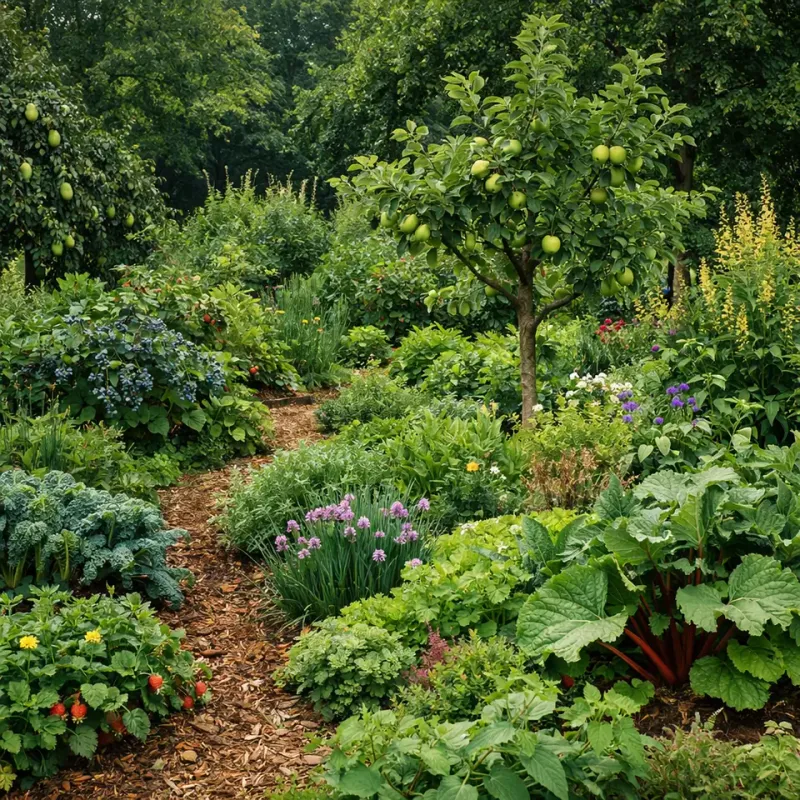
Established food forest path winding through trees, shrubs, and groundcover

Water + access + maintenance

Food Forest Integration

Ecological layers arranged around practical irrigation, protection, harvest paths, equipment access and workload.

Operating method

Perennial establishment: survival before sales

Biological feedback is slow, so design mistakes are controlled through observation, small cohorts and explicit stop conditions.

  1. 01

    Read the site

    Observe sun, frost pockets, drainage, wind, wildlife, soil and access for a full season.

  2. 02

    Prepare water & soil

    Use testing, mulch, irrigation and only site-appropriate water-spreading earthworks.

  3. 03

    Plant framework

    Establish windbreaks, canopy trees, berries, pollinator strips and functional groundcovers.

  4. 04

    Protect & train

    Install guards, stake and prune, scout disease and retain replacement stock.

  5. 05

    Allocate harvest

    Reserve household use, storage and propagation before identifying genuine surplus.

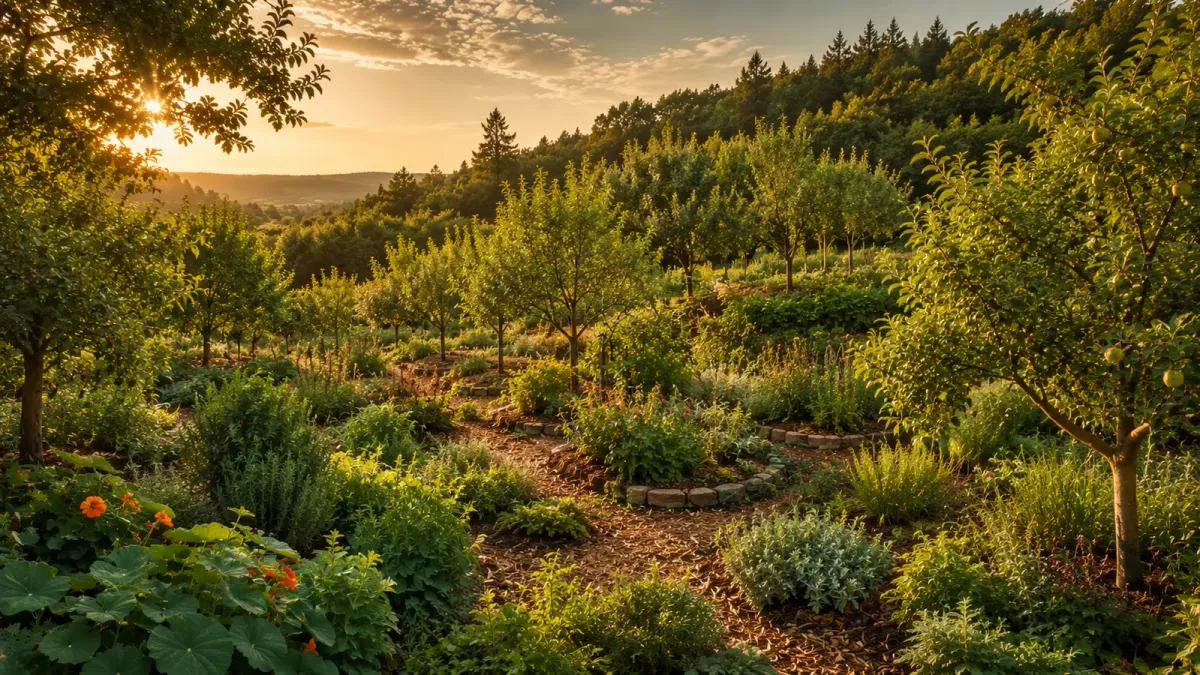
Wide food forest orchard at golden hour with layered perennial plantings
Land improvement first · revenue last
Orchard path crossing a dense edible understory beneath mature trees
Every vegetation layer needs a defined function
Explore the Full Orchard PlanDiscuss future fitDetailed site criteria, planting capital, harvest allocation and survival gates

2026-2035 roadmap

Preparation first. Launch gates second.

No business projection begins before 2029. Property-based phases move later if financing, site selection, zoning or utility capacity is not ready.

Dates after 2029 are gates, not promises.Mobile welding and compact digital work can continue without forcing the fixed shop or farm timeline.
  1. 2026-2028

    Foundation

    Trade school, apprenticeship or employment entry, corporate maintenance and personal savings.

    Success gateTraining complete; employment path established; no premature capital build.
  2. 2029

    Controlled launch

    Register and insure Fabrication & Welding, begin limited mobile service and establish internal 3D capability.

    Success gatePositive job-level contribution with a controlled one-person schedule.
  3. 2030-2031

    Validation

    Build repeat local customers, refine estimates, add selective used tools and test external 3D demand.

    Success gateCorporate activity covers fixed overhead and a replacement reserve.
  4. 2032-2033

    Property integration

    Acquire a compatible homestead, commission the fixed shop, and establish greenhouse and orchard systems.

    Success gateThe property supports operations without excessive new debt.
  5. 2034-2035

    One-person maturity

    Maintain a stable trade side line, selective 3D work, reliable household food production and genuine surplus sales.

    Success gateWorkload remains sustainable and the corporation stays cash-positive.

Capital discipline

Smaller, staged and repairable by design

The base plan allocates $24.9k of corporate capital from 2029 through 2035, excluding property, buildings, ordinary household systems and any replacement vehicle. Every optional asset must have a credible utilization case and base-case payback within 24 months.

  1. 01

    Safety first

    Legal filings, contracts, insurance, PPE and fire controls precede revenue equipment.

  2. 02

    Revenue tools next

    Mobile tools that directly permit safe paid work receive priority.

  3. 03

    Remove proven bottlenecks

    Upgrades follow job records showing repeated lost time, outsourcing cost or rejected demand.

  4. 04

    Fixed systems last

    The homestead shop and farm lines wait for property, zoning, utilities and actual-use review.

Fluxology is currently in the foundation period. Future-fit customer needs, supplier relationships and local collaboration conversations are welcome; active service booking is not yet open.

Start a future-fit conversation

Foundation period · pre-launch

Planning & Future Project Inquiries

Share a future customer need, supplier relationship, local collaboration idea or question about the staged operating plan. Active service booking is not yet open.

Contact

Email: info@fluxology.ca

Current Phase

2026-2028 foundation period
Training, employment entry, corporate maintenance and launch preparation
Earliest commercial target: 2029

Useful Inquiries

Future customer problems, local market validation, supplier relationships, used-equipment leads, rural collaboration and questions about the operating plan.